
Effective Digital Marketing: Integrating SEO Strategies, Content Marketing, and Social Media Advertising for Online Success
Authored by hdtoday.id, Mar 10, 2026
Most businesses that struggle with digital marketing are not failing because they lack effort - they are failing because they treat three interconnected disciplines as separate activities. A company might publish excellent blog content that nobody finds, run social media accounts with no clear purpose, and invest in paid advertising with no supporting content to justify the click. Each channel operates in isolation, and the combined result is far weaker than the sum of its parts.
Effective digital marketing is fundamentally an integration problem. The brands that consistently generate traffic, leads, and revenue online have figured out how to make their organic visibility, their content, and their paid social efforts reinforce one another. Tools and platforms that support multi-channel account management - such as accmarket - have gained relevance precisely because managing several advertising environments simultaneously has become a practical necessity for serious online marketing operations.
This article covers the three core pillars of modern digital marketing - organic visibility through optimized content, content marketing as a long-term authority builder, and social media as both an organic and paid distribution channel - and explains how to integrate them into a cohesive strategy. The goal is a practical, honest guide that reflects how these systems actually work, not how they are ideally described in a marketing brochure.
Understanding the Digital Marketing Ecosystem
Digital marketing is not a single discipline - it is a collection of related practices that share a common objective: reaching the right people at the right moment with the right message. Understanding the ecosystem before committing to tactics prevents the most common and expensive mistake in online marketing: building individual channel strategies with no shared logic connecting them.
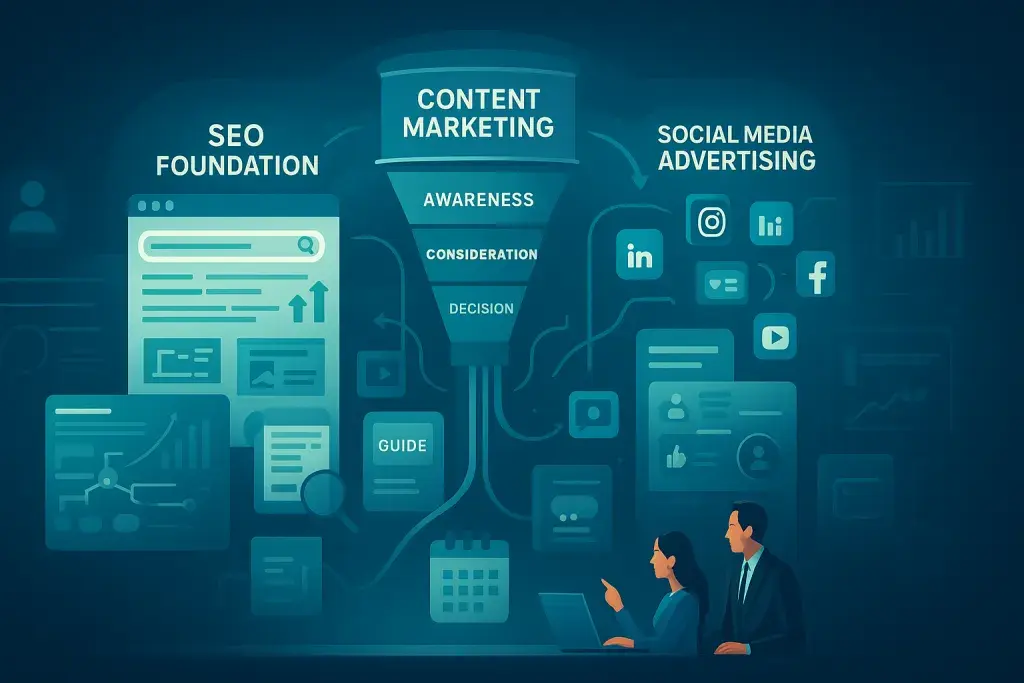
At the core of the ecosystem are three mutually dependent activities. First, content marketing - the creation and distribution of material that informs, educates, or entertains an audience in ways that build trust and drive action over time. Second, organic visibility through structured optimization - the process of ensuring that content reaches people who are actively looking for what you offer. Third, social media marketing - the use of platforms to distribute content, build community, and run paid campaigns to extend reach beyond existing audiences.
Surrounding these three pillars are enabling disciplines: online advertising through paid search and display networks, email marketing, conversion rate optimization, and analytics. These supporting systems do not replace the three core pillars - they amplify them. A brand running paid social ads without strong content to back them up will pay high costs for underwhelming results. A brand producing excellent content with no distribution plan will see that content go largely unread.
- Organic content distribution through optimized articles, guides, and multimedia
- Social media marketing through both organic posting and paid campaigns
- Online advertising through paid placements in search, display, and social environments
- Email marketing for direct audience communication and lead nurturing
- Analytics and attribution for measuring what drives real business outcomes
The ecosystem metaphor is deliberate: remove one component and the balance shifts. The sections that follow treat each pillar seriously on its own terms before showing how they function best when connected.
Building a Strong SEO Foundation
Organic visibility is earned, not purchased - and earning it requires a systematic approach to how content is structured, targeted, and technically delivered. Brands that invest in this foundation benefit from compounding returns: content that ranks well continues generating traffic long after the initial effort. Those that skip this foundation find themselves permanently dependent on paid channels, which stop working the moment the budget runs out.
Keyword Research and Search Intent
The starting point for any structured visibility strategy is understanding what your audience is actually searching for - and what they expect to find when they search. Two searches may use similar words but carry entirely different intent. Someone searching for "content marketing examples" is looking to learn; someone searching for "content marketing agency for SaaS" is evaluating options before making a decision. Writing content that matches the intent behind a search, not just the surface language, is what determines whether that content performs or disappears.
Keyword research surfaces the specific phrases your audience uses, estimates how often they are searched, and reveals how competitive it is to rank for them. The practical output of keyword research is not a list of terms to repeat mechanically - it is a map of topics organized by relevance, intent, and realistic ranking potential.
- Short-tail keywords - broad terms with high search volume and intense competition
- Long-tail keywords - specific phrases with lower volume but higher conversion intent
- Informational keywords - used by audiences seeking to understand a topic
- Transactional keywords - used by audiences ready to take action or make a purchase
- Local keywords - used by audiences searching for geographically specific solutions
Prioritizing long-tail and intent-specific keywords is typically the more productive approach for businesses that are not yet established authorities in their category. Ranking for highly specific queries is more achievable, and the audiences those queries attract are further along in their decision-making process.
On-Page SEO Essentials
Once you know which topics to target and what intent to serve, every page of your website needs to communicate its relevance clearly - to both the reader and the algorithms that evaluate it. On-page optimization refers to the specific elements within each page that determine how well it signals its topic, quality, and relevance.
| On-Page Element | Purpose | Best Practice |
|---|---|---|
| Title Tag | Signals the page topic and appears in results | Include the primary keyword naturally within 60 characters |
| Meta Description | Influences whether users click through | Write a specific, compelling summary under 155 characters |
| Header Structure (H1-H3) | Organizes content and signals hierarchy | Use one H1 per page; include relevant terms in H2 and H3 naturally |
| Internal Links | Distributes authority and aids navigation | Link to related pages using descriptive, relevant anchor text |
| Image Alt Text | Improves accessibility and contextual signals | Describe the image accurately, including keywords only where genuinely relevant |
| Page Speed | Affects user experience and ranking performance | Aim for fast load times, especially on mobile devices |
These elements are not independent checkboxes - they work together to communicate the quality and relevance of a page. A well-written article with a weak title tag and no internal linking structure will consistently underperform compared to equivalent content that is properly configured.
Technical SEO and Site Architecture
Technical optimization addresses the infrastructure beneath your content. Even excellent, well-targeted writing will underperform if the website delivering it has structural problems that prevent it from being crawled, indexed, or loaded efficiently. Technical issues are invisible to most readers but highly visible to the algorithms evaluating your site.
Site architecture - the way pages are organized and linked to one another - determines how authority flows through a domain. A flat, logical structure where important pages are reachable within a few clicks tends to perform better than a disorganized hierarchy where content is buried deep and rarely linked. The goal is a site where every important page is easy to find, both for visitors and for automated crawlers.
- Mobile-first design with fully responsive layouts across device types
- HTTPS implementation and current security protocols
- XML sitemap submission and correctly configured robots directives
- Core Web Vitals performance - loading, interactivity, and visual stability
- Canonical tags to resolve duplicate content across multiple URLs
- Structured data markup to qualify for enhanced results in search listings
Off-Page SEO and Authority Building
Authority in the context of organic visibility is largely determined by who links to you and why. When reputable websites reference your content as a credible source, it signals trustworthiness. A single link from a well-regarded industry publication typically carries more weight than dozens of links from low-quality directories. The quality and relevance of linking sources matters far more than quantity.
Building this kind of authority requires producing content worth referencing, then actively cultivating the relationships and distribution channels that get it in front of the right people. Digital PR, genuine partnership content, expert commentary in relevant publications, and the kind of original data or analysis that others want to cite are all legitimate and durable approaches.
- Guest contributions to respected publications in your industry vertical
- Digital PR placements that result in editorial references and links
- Broken link outreach - identifying dead resources and offering your content as a replacement
- Brand mention monitoring and converting unlinked references into active links
- Creating original research, tools, or resources that naturally attract citations
Content Marketing: Creating Value That Drives Results
Content marketing occupies a specific and important position in the digital marketing mix. It is not advertising - it does not interrupt. It is not pure brand-building - it must drive measurable outcomes. It is the practice of creating material that answers real questions, solves real problems, and builds genuine trust over time, so that when an audience is ready to act, your brand is the natural choice.
Defining Your Content Strategy
A content strategy is the decision-making framework that governs what you create, for whom, through which channels, and toward which business goals. Without it, content production becomes reactive: responding to requests, chasing trends, and publishing without a coherent accumulation of topical authority. With it, every piece of content serves a defined purpose and builds on what came before.
The strategy development process begins with audience understanding - not assumptions about your audience, but genuine research into their questions, frustrations, goals, and the language they use to describe all of the above. From there, a content plan maps formats and topics to stages of the buyer journey, establishes realistic publishing cadences, and creates a repurposing system so that each significant piece of content generates value across multiple formats and channels.
- Define target audience personas based on research, not assumptions
- Map content types to awareness, consideration, and decision stages
- Identify the two or three channels where your audience is most active and receptive
- Set specific, measurable content goals tied to business outcomes
- Build a rolling editorial calendar with consistent publishing frequency
- Create a repurposing workflow so core content extends across formats and platforms
Content Types and Their Role in the Funnel
Different content formats serve fundamentally different purposes depending on where an audience member is in their relationship with your brand. A person who has just encountered your brand for the first time needs something different from someone who has already evaluated your offering and is weighing a final decision. Treating every piece of content as if it serves the same audience at the same moment is one of the most common and costly content marketing errors.
| Funnel Stage | Reader's Goal | Effective Content Types | Primary Distribution Channel |
|---|---|---|---|
| Awareness | Discover and understand a topic or problem | Blog posts, explainer videos, infographics, podcasts | Organic search, social media |
| Consideration | Compare options and evaluate solutions | In-depth guides, webinars, case studies, email sequences | Email, retargeting, organic search |
| Decision | Confirm a choice and take action | Testimonials, product demos, comparison pages, free trials | Landing pages, direct outreach, paid ads |
The most effective content programs maintain output across all three stages simultaneously. Producing only top-of-funnel content builds audience but not revenue. Producing only bottom-of-funnel content reaches too small a pool of people already prepared to buy. Balance, informed by data on where your pipeline has gaps, is what drives sustainable growth.
Writing and Optimizing Content for Both People and Search Engines
The tension between writing for human readers and writing for algorithmic visibility is largely a false one when approached correctly. Content optimized purely for keyword density and structural signals reads mechanically and fails to hold attention. Content written purely for reader experience, with no attention to how it will be discovered, often goes unread entirely. The practical solution is to write for people first - answer their questions completely, clearly, and with genuine expertise - then apply optimization discipline to maximize how that content is found.
- Place the primary topic keyword naturally in the opening paragraph and relevant headers
- Use descriptive subheadings that communicate content structure to both readers and crawlers
- Answer the core question the content promises to address early, not buried in the conclusion
- Include specific examples, data points, and practical guidance rather than general commentary
- Link to related content within your site to support reader navigation and signal topical depth
- Write compelling, specific title tags and meta descriptions that reflect actual page content
- Revisit and update published content regularly to maintain accuracy and relevance
Measuring Content Marketing Performance
Content marketing measurement fails most often when it focuses on activity metrics - how many articles were published, how many social shares were accumulated - rather than outcome metrics that connect to business results. Vanity metrics can be high while pipeline contribution remains flat. The measurement framework needs to trace a line from content interaction to revenue impact, even if that line runs through several attribution touchpoints.
| Metric Category | Example Metrics | What It Reveals |
|---|---|---|
| Traffic | Organic sessions, referral visits, direct traffic | How effectively content attracts visitors from relevant sources |
| Engagement | Time on page, scroll depth, bounce rate | Whether content sustains attention and delivers on its promise |
| Conversion | Lead form completions, email signups, purchases | Whether content moves readers toward business action |
| Organic Visibility | Keyword positions, impressions, click-through rate | How well content competes for relevant search traffic |
| Social Amplification | Shares, saves, comments, mentions | Content resonance and potential for earned distribution |
Social Media Marketing: Building Reach and Engagement
Social media marketing operates on a different timeline and rhythm than organic content. Where a well-optimized article might accumulate traffic gradually over months, a social post reaches its potential audience within hours or days. This immediacy makes social platforms uniquely valuable for distribution, community building, and real-time brand presence - but it also means the results are less durable without a supporting content foundation.
Choosing the Right Platforms for Your Audience
Platform selection is a strategic decision, not a matter of being everywhere simultaneously. Each major platform has a distinct user demographic, a dominant content format, and an algorithmic logic that rewards certain behaviors over others. Matching your brand's audience profile and content capabilities to the platform where that match is strongest produces better results than spreading identical content across every available channel.
| Platform | Primary Audience | Best Content Formats | Most Effective For |
|---|---|---|---|
| Younger adults, visually engaged consumers | Images, short video, Stories | Lifestyle brands, e-commerce, visual products | |
| Professionals, B2B buyers, decision-makers | Articles, thought leadership posts, video | B2B companies, professional services, recruiters | |
| Broad adult demographics | Video, group content, events, paid ads | Community-oriented brands, local businesses | |
| TikTok | Younger audiences, entertainment-focused | Short-form vertical video | Consumer brands, entertainment, trend-driven content |
| YouTube | All age groups, research and learning intent | Long-form video, tutorials, product reviews | Education, product demonstrations, brand authority |
| X (formerly Twitter) | News followers, technology, finance sectors | Text posts, threads, real-time commentary | Thought leadership, industry commentary, rapid engagement |
The practical recommendation for most businesses is to identify two or three platforms where their target audience is demonstrably active and commit to building a genuine presence there before expanding. Shallow activity across many platforms consistently underperforms focused, consistent effort on fewer.
Organic Social Media Strategy
Organic social media is the discipline of building an audience and maintaining a brand presence without paid distribution. Its reach has narrowed on most major platforms over the past decade as algorithmic curation has reduced the proportion of followers who see any given post without amplification. Despite this, organic social remains important for brand personality, community engagement, and the kind of authentic relationship-building that paid advertising cannot replicate.
Effective organic social is driven by consistency, relevance, and genuine engagement. Brands that treat their social accounts as broadcast channels - pushing announcements and promotions without responding to comments or participating in conversations - typically see declining engagement over time. Audiences on social platforms have high expectations for responsiveness and authenticity.
- Develop a consistent brand voice and visual identity that carries across all platforms
- Prioritize content that invites response - questions, opinions, shared experiences - over pure broadcasting
- Respond to comments, direct messages, and mentions to reinforce community and trust
- Use platform-native features such as Stories, polls, and short-form video to align with algorithmic preferences
- Incorporate user-generated content to build social proof and diversify your content mix
- Review platform analytics regularly to identify which content types generate the most meaningful engagement
Paid Social Media Advertising
Paid social advertising - a central component of modern online advertising - offers something organic channels cannot: precise audience targeting at scale. Platforms hold detailed data about their users' demographics, interests, online behaviors, and purchasing patterns. Advertisers can use this data to reach highly specific audiences, including people who have never encountered their brand before and people who have visited their website but not yet converted.
The strength of paid social campaigns lies in the combination of targeting precision and creative flexibility. Unlike traditional advertising, social ads can be tested rapidly, adjusted in real time, and scaled based on measurable performance data. The weakness is equally clear: the moment you stop spending, the results stop. Paid social is a distribution accelerant, not a substitute for the organic authority that content marketing and structured optimization build over time.
- Awareness campaigns - reach new audiences and build recognition at scale
- Engagement campaigns - amplify content to drive meaningful interaction
- Traffic campaigns - direct targeted users to landing pages, articles, or product pages
- Lead generation campaigns - capture contact information directly within the platform interface
- Conversion campaigns - optimize for specific purchase or signup actions
- Retargeting campaigns - re-engage users who have previously interacted with your brand or website
Integrating SEO, Content Marketing, and Social Media for Maximum Impact
Integration is where strategy becomes genuinely powerful. Each of the three pillars covered so far produces meaningful results when managed well individually. But their full potential is realized only when they are aligned around shared goals, shared audiences, and a shared content infrastructure. The brands that dominate their categories online are almost universally those that have figured out how to make these systems feed into one another.
How the Three Pillars Support Each Other
The relationship between the three pillars is circular and self-reinforcing. Research into what people are searching for informs which content topics to prioritize. High-quality content on those topics attracts inbound links from other sites, which strengthens the domain's organic authority, which improves the ranking performance of future content. Social media distributes that content to audiences who might not have found it through organic channels, generating engagement signals and additional inbound links. Those links further strengthen authority. The cycle continues.
Content marketing provides the raw material that makes the other two pillars work. Without substantive content, there is nothing to optimize for organic visibility and nothing worth distributing on social platforms. Without organic visibility strategy, content remains largely invisible to the audiences actively searching for what it covers. Without social distribution - both organic and paid - content reaches only the fraction of your potential audience that already knows where to find you.
- Keyword research shapes the content calendar and determines which topics to prioritize
- High-quality content earns backlinks that build domain authority over time
- Social sharing generates traffic and indirect signals that support organic performance
- Content provides the substance for organic social posts, paid ad copy, and email campaigns
- Social engagement data identifies which content resonates, informing future content and keyword strategy
- Paid social campaigns can accelerate the early distribution of newly published content before organic rankings develop
Building an Integrated Digital Marketing Plan
An integrated plan is not three separate channel plans assembled in the same document. It is a unified strategy that begins with shared audience understanding and shared goals, then assigns specific roles to each channel based on what each does best. The production and distribution workflow connects every output - from a long-form guide to a fifteen-second video clip - back to the same strategic intent.
- Define shared audience personas and business goals that apply across all channels
- Conduct comprehensive keyword research and use findings to build the content calendar
- Create substantial cornerstone content pieces optimized for your primary target topics
- Break each cornerstone piece into derivative formats - short social posts, infographics, video clips, newsletter excerpts
- Distribute organic social content with platform-native adaptations, not identical reposts
- Amplify top-performing organic content with targeted paid social campaigns
- Track cross-channel performance in a unified reporting system
- Feed data insights back into content topic selection, ad targeting, and optimization priorities on a regular cycle
Common Integration Mistakes and How to Avoid Them
Integration sounds logical in principle, but in practice most organizations default to siloed execution. Different teams own different channels, use different tools, measure success differently, and rarely share insights across boundaries. The result is a digital marketing operation that looks integrated in strategy documents but functions in fragments in practice.
The most persistent integration failures share recognizable patterns. Understanding them in specific terms is more useful than generic warnings about "alignment."
- Siloed teams - organic visibility, content, and social teams that operate independently and rarely share data or creative assets
- Inconsistent messaging - different value propositions or brand voices across channels confuse the audience and dilute positioning
- No repurposing system - every piece of content is built from scratch for each channel, multiplying production costs and reducing output consistency
- Vanity metric focus - optimizing for impressions and follower counts rather than qualified traffic, leads, and revenue
- Broken feedback loop - performance data is collected but not consistently fed back into strategic decisions across channels
Measuring Digital Marketing Success: Analytics and KPIs
Measurement is what separates a digital marketing strategy from a digital marketing experiment. Every channel in an integrated program generates data, and that data has two distinct functions: accountability (did we achieve what we set out to achieve?) and learning (what do these results tell us about what to do differently?). Most marketing teams handle the first function reasonably well. The second - treating data as an ongoing source of strategic insight - is where meaningful competitive advantage is built.
Key Performance Indicators Across Channels
Channel-specific KPIs are necessary for diagnosing performance at the operational level. But they must always connect upward to business outcomes - revenue generated, cost per acquired customer, retention rates, and lifetime value. When channel metrics and business outcomes are tracked in parallel, it becomes possible to have honest conversations about where investment is producing returns and where it is not.
| Channel | Primary KPIs | Business Outcome Connection |
|---|---|---|
| Organic Visibility | Organic traffic, keyword positions, click-through rate, domain authority | Inbound leads, organic revenue contribution, brand discoverability |
| Content Marketing | Page views, time on page, lead magnet downloads, email signups | Pipeline contribution, audience nurturing, conversion rate by content type |
| Organic Social | Reach, engagement rate, follower growth, profile link clicks | Brand awareness, referral traffic, community loyalty indicators |
| Paid Social | Cost per click, cost per lead, return on ad spend, conversion rate | Direct revenue, lead acquisition cost, campaign ROI |
| Email Marketing | Open rate, click rate, unsubscribe rate, revenue per send | Customer retention, repeat purchase rate, pipeline acceleration |
Tools for Tracking and Reporting
The right analytics stack depends on the scale and complexity of your operation, but certain categories of tools are non-negotiable for any serious digital marketing program. Website analytics, organic visibility monitoring, paid campaign reporting, and social media performance tracking each require dedicated tooling - and ideally, a layer of unified reporting that pulls all of that data into a single view.
- Website analytics platforms - track visitor behavior, traffic sources, and conversion events on your site
- Organic performance tools - monitor keyword positions, backlink profiles, and technical site health
- Paid campaign managers - platform-native dashboards for managing and measuring paid social and display advertising
- Social media management tools - unified publishing, scheduling, and analytics across multiple platforms
- CRM and marketing automation - connect marketing activity to sales pipeline and customer data
- Custom reporting dashboards - aggregate data from multiple sources into coherent, decision-ready reports
Tool selection matters less than the discipline of actually using the data these tools produce. A team that consistently reviews performance, draws honest conclusions, and adjusts strategy accordingly will outperform a team with more sophisticated tooling but no systematic review process.
Practical Steps to Launch and Scale Your Digital Marketing Strategy
Theory without execution is marketing philosophy, not marketing practice. What follows is a realistic, sequential approach to building and scaling an integrated digital marketing program - one grounded in the order in which decisions and infrastructure genuinely need to be established, rather than an idealized process that assumes resources and capabilities that most organizations do not have at the outset.
- Audit your current digital presence - assess your website's technical health, existing content library, social media account status, and organic visibility baseline before investing in new activity
- Build detailed audience personas - develop profiles based on actual customer data and research, capturing demographics, behaviors, goals, and the specific language your audience uses
- Set specific, measurable goals - define what success looks like for each channel in concrete terms tied to business outcomes, not just activity volume
- Establish your keyword and content foundation - conduct thorough keyword research and build a 90-day editorial calendar aligned to audience intent
- Resolve technical website issues - address crawlability, speed, mobile usability, and structural problems before scaling content production
- Launch consistent organic social activity - establish a publishing rhythm on selected platforms and begin genuine audience engagement
- Test paid social advertising with controlled budgets - run small-scale experiments with different creatives and audiences before committing significant budget
- Implement tracking and unified reporting - configure analytics tools and establish a regular review cadence before you need the data
- Review, learn, and adjust - use 30 to 90-day performance reviews to refine priorities, reallocate resources, and build on what is demonstrably working
Scaling is not about expanding every activity simultaneously. It is about identifying the highest-performing content formats, channels, and audience segments, then concentrating effort and budget there before broadening. Premature scaling of an unproven channel wastes resources that could compound on one that is already working.
Questions and Answers
How do I know which content topics will actually attract organic traffic versus just generating internal interest?
Keyword research tools show you estimated monthly search volumes for specific queries, giving you a data-based view of real audience demand rather than internal assumptions. Topics that generate strong organic traffic are those where search volume exists, intent matches your content, and your domain has a realistic chance of competing for visibility. If a topic has no measurable search demand, it may still have value for social distribution or email - but do not expect organic traffic from it.
Is paid social advertising worth the investment for a business with a very small budget?
Yes, but only with focused targeting and realistic expectations. Small budgets work best when concentrated on one or two specific campaign objectives - typically traffic or lead generation - rather than spread across awareness and conversion campaigns simultaneously. Start with retargeting campaigns targeting people who have already visited your website, as this audience is warmer and typically converts at lower cost than cold audiences.
How often should existing content be updated to maintain its organic performance?
Content that targets competitive or time-sensitive topics should be reviewed at least annually; evergreen foundational content can sustain performance longer with less frequent updates. The signal that a piece needs attention is declining organic traffic or ranking positions, not the passage of time alone. Updates should add new information, improve accuracy, and refresh examples - not simply rewrite content that is already performing well.
What is the most common reason an integrated digital marketing strategy fails to produce results?
The most common cause is insufficient patience combined with premature pivoting. Organic content marketing and structured visibility strategies operate on timelines measured in months, not weeks. Teams that abandon an approach after six weeks because results are not yet visible typically never allow the compounding effects of integration to materialize. The second most common cause is measuring the wrong things - optimizing for channel activity rather than business outcomes.
How should a business decide how to split budget between content marketing and paid online advertising?
There is no universal ratio, but a practical starting framework is to prioritize content and technical infrastructure in the early stages when authority and assets are being built, then introduce paid advertising to accelerate distribution once there is proven content worth amplifying. Over time, data on cost per lead across channels should guide reallocation. Paid advertising should complement organic efforts, not substitute for the long-term foundation that content marketing provides.
Can social media marketing directly improve organic visibility performance?
Not directly through algorithmic ranking factors - social signals are not a documented direct ranking input. The indirect effects, however, are real and significant. Social distribution increases the number of people who encounter your content, which increases the probability that some of them will link to it from their own websites or mention it in their own publications. Those earned links do improve organic authority. Social platforms are therefore a distribution accelerant for the kind of content that organically attracts links over time.